Code of the Vigilante
Or where "Citizen Vigilante" crosses the line

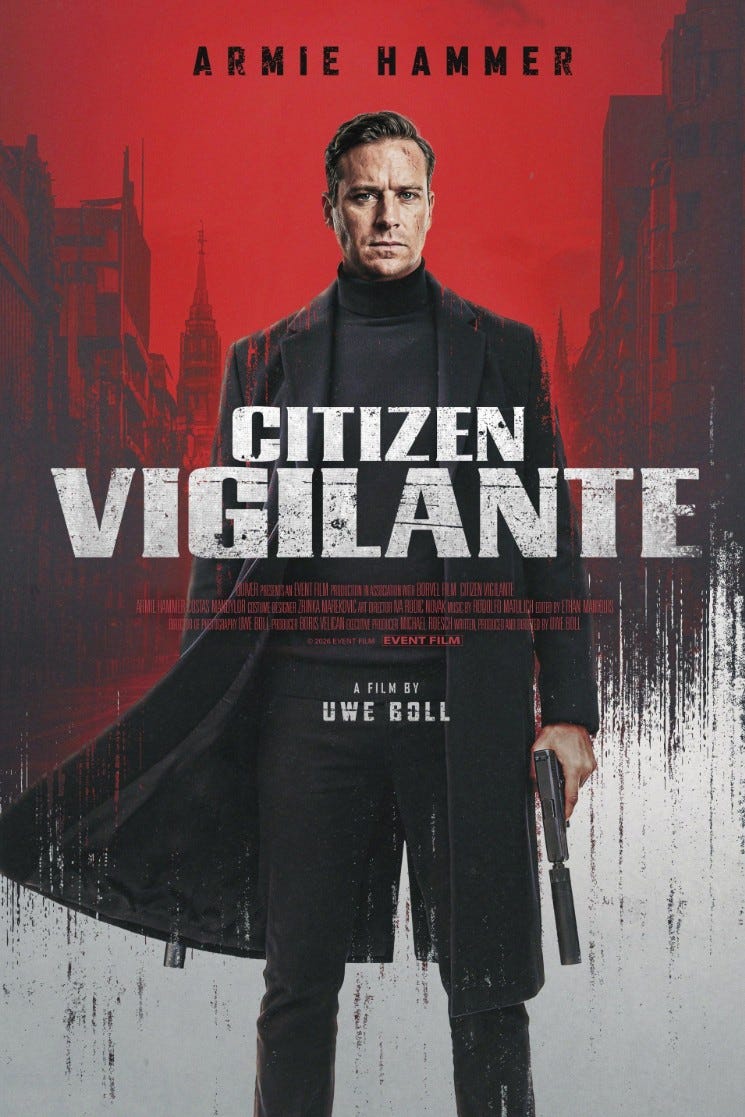
I’ve saw Citizen Vigilante (2026) a few days ago and reviewed it. The movie was already exploding on social media and various streaming services and since then has become the number one film on Amazon and number two on Apple TV.
I can totally understand why the movie is so popular. Day-to-day actual events in the UK and Europe do nothing but emphasize the film’s message that the police, the courts, and the governments of these nations have failed their citizens in allowing violent immigrant crime to go unchecked.
In spite of this (or some say maybe because of it), a lot of people have criticized the film for being anti-immigrant, anti-Muslim, and pro-violence against immigrants. After all, you don’t want to paint 100% of immigrant Muslims with the same broad brush assuming they are ALL rapists and murders, do you?
On the surface, Armie Hammer’s character Michael Sanders (Citizen Vigilante) is defending the defenseless, seeking justice for the victims, and he’s doing it all for them. The characters says so on his video messages to the public: “I’m doing this for you until you learn to do it for yourselves.”
Citizen Vigilante is the most recent of a long, long list of vigilante films so you would think there’s a market for them. These films are made when the public believes the system has failed them and their only recourse for justice is for someone to take the law into their own hands and to fight back for them.
However, even a vigilante movie has rules, maybe not a lot of them, but there has to be something that separates the law-breaking vigilante from the people he or she hunts down and sometimes guns down.
Google’s AI did a quick search and found six core rules for the vigilante in fiction:
The System is Broken: The hero tries to use the normal police and courts, but the legal system fails. This gives them a reason to break the law.
The “Eye for an Eye” Rule: Punishments fit the crime. If a bad guy hurts a family, the hero gives them the same pain back.
Targeting the Guilty: Heroes only hurt or kill the people who actually did wrong. They protect kids, pets, and innocent bystanders.
Moral Gray Areas: The hero breaks the law to do the right thing. This blurs the line between the “good guy” and the “bad guy.”
Weapons over Words: When talking fails, the hero uses intense physical fights, martial arts, or guns to win.
Almost every vigilante movie I’ve ever watched follows these rules (more or less). It’s what keeps the vigilante character sympathetic to the audience and allows us to identify with his or her righteous indignation. Even if we’re not the sort of person who could commit those actions (most of us aren’t), we can understand why our hero can and does.
Now let’s take Michael Sanders.
There are two scenes where Sanders crosses the line, in one of them literally.
In the first scene, Interpol Chief Henry (Costas Mandylor) tracks Sanders to his supposed home. It’s a trap and Sanders is inside an armored box with two automatic rifles pointing into the outer room. Police enter the outer room and face this scene. Sanders says he understands they’re just doing their jobs but if they don’t leave he will be forced to kill them.
Of course they don’t leave, so he cuts them down in a hail of gunfire, splattering their blood and flesh all over the place. Then, after Sanders has apparently left, the officers who are still alive break in to his bunker only to set off an explosive (I saw this coming a mile away). More officers are killed and Chief Henry is seriously injured.
The minute Sanders killed police officers in cold blood, he stopped being sympathetic. He could have just left without hurting anyone and blew up his escape route to keep them from following. He would still have gotten away and would also have sent a message that only the guilty will be hurt or killed.
The second scene involves his kidnapping of a corrupt judge who allowed six teenage rapists to go free “reasoning” that they raped a 14-year-old girl because they were having an “adjustment crisis” or some such bull.
On the drive to where Sanders was going to execute the judge, he explains to the drugged judge that as a side effect of their national propaganda, they’ve created a nation of sheep, people who would rather put themselves in mortal danger than risk disobeying the law.
To prove his point, Sanders crosses into the opposing lane putting his vehicle directly in the path of an oncoming car. The oncoming car swerves into a ditch causing it to crash and explode (cars don’t explode when they crash unless they are soaked in gasoline and carrying high explosives, but whatever).
Sanders makes the point that the driver could have survived if he had just crossed the center line going into the “wrong” lane. But the inhibition against breaking the law was so extreme that the driver didn’t even think of that option and instead, ended up dead (Sanders didn’t take into consideration that the drive could have panicked).
Except Sanders knowing what they would do deliberately caused the death of innocent people. It might be different if he knew in advance that a group of terrorists were in the car, but then of course, terrorists wouldn’t be inhibited in the manner Sanders wanted to demonstrate.
So, our vigilante deliberately murdered scores of police officers who were just performing their duty and the driver and passengers of a car he happened to encounter when he needed to illustrate a point.
No reasonable person could possibly identify with and have sympathy for the vigilante after all this. The vigilante is just as dangerous if not more so than the people he is seeking to bring to justice.
In any vigilante movie, the protagonist breaks the law and, if captured, will be arrested, tried, and convicted of the laws they’ve broken. In most cases, they aren’t caught or if captured, manage to escape so they can continue their much needed activities. We still cheer the vigilante on because we can understand why he has broken the law and violating those particular laws still allow us to forgive him.
However, Sanders is not just a vigilante, he’s a total loose cannon. He appears throughout the movie as very rigidly controlled in every action. He’s severe, uncompromising, not the least bit sentimental, and has no inhibitions against violence against anyone. Somewhere inside though, he must either be sitting on a great deal of rage or is a sociopath incapable of distinguishing right and wrong in his own actions while still condemning others.
Some have criticized the vigilante’s murdering, not only of the teenage rapist, but also his father, mother, and sister. The justification was that the family expressed no remorse for the boy’s actions whatsoever and his sister said that the victim was at fault for dressing provocatively. The father said he has been teaching his children his family values and those from the Quran (implying these values allow for the rape of non-Muslim girls).
I guess that could be considered enough justification for their execution.
But the two main points stand. Sanders is willing to kill not just anyone who gets in his way but anyone at all if it suits a whim.
The movie and possibly any sequels will continue to gather a massive following because of the vigilante’s main activities, killing perpetrators of violent immigrant crime when the authorities refuse to hold these criminals accountable.
However make no mistake, Sanders is dangerous not just to the bad guys but to everyone. He will punish the guilty but in the process, he won’t make any effort to protect innocent bystanders or to mitigate collateral damage.
The question is whether or not director Uwe Boll intended his protagonist to cross this far over the line. Maybe he thought that the audience’s response to seeing rapists and murderers killed for their crimes would allow them to overlook Sanders’ fatal flaws.
Are we willing to make a hero out of someone who kills the innocent along with the guilty?